
It is located in the place of Cabeço da Senhora dos Prazeres, parish of Benespera, municipality of Guarda, in the Centro region, sub-region of Beiras and Serra da Estrela
The Cabeço das Fráguas Archaeological Site or just Cabeço das Fráguas, is located next to Quinta de S. Domingos, in the place of Cabeço da Senhora dos Prazeres, parish of Benespera, in the municipality and district of Guarda.
Access is only possible on foot and with some difficulty as it takes almost an hour to climb the steep hill on the north flank (the most favorable for the climb).
Cabeço das Fráguas is an archaeological site of the greatest importance relating to an ancient place of worship of Lusitanian deities dating back to the 17th century. V BC.
At the top of the hill there is an archaeological excavation that proves the existence of some Lusitanian buildings possibly intended for worship.
In the vicinity of the hill, 20 religious “aras” contemporary with the Lusitanians were found, which is of the greatest importance since, by comparison, in the entire neighboring province of Salamanca, Spain, there are only 18 “aras”.
The hill could be the place of Viriathus's death and his possible funeral ceremonies in the form of cremation in a funeral pyre equivalent to the tomb in other funeral cultures.
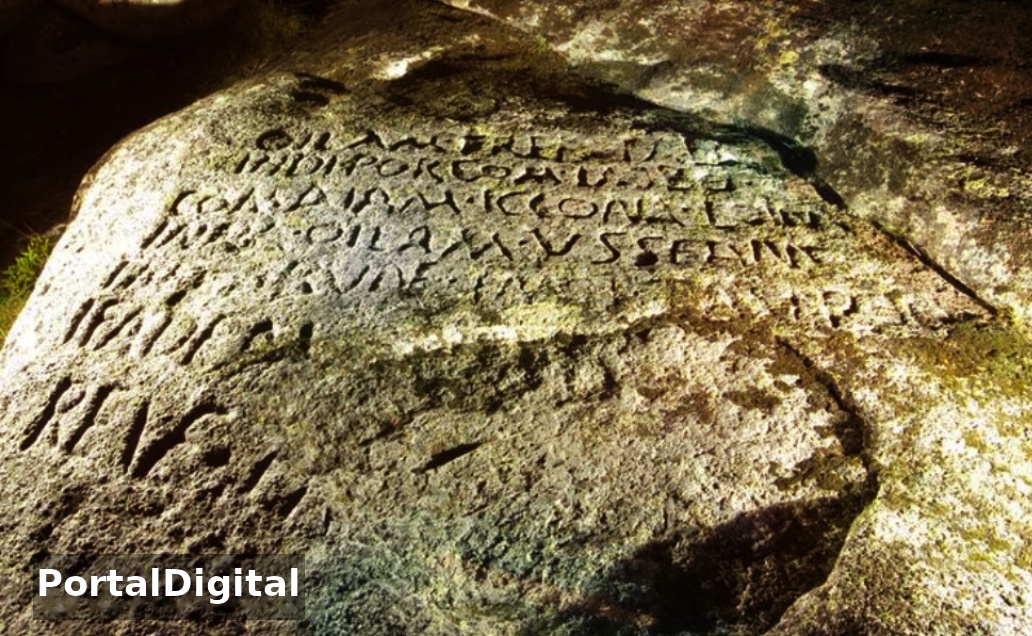
The inscription on the slab reads: “Trebopala a sheep and Laebo a pig, Iccona Loiminna a cow, Trebaruna a yearling ewe and Reva Tre-(?) a breeding bull”.
The inscription on the slab was reproduced using laser scanning equipment and a mold of it is on display at the Guarda museum.
New technologies provide information about an ascent to Cabeço das Fráguas by elements linked to the Guarda Mountaineering Club.
Cabeço das Fráguas stands out in the landscape 200 meters above the plateau that occupies the northwestern top of the municipality of Sabugal and is however already located in the parish of Benespera, municipality of Guarda.
Starting on a rural path where cars can be parked and the climb is at a good pace because there are no trails.
The panorama from the summit is superb where the visitor can see beyond the city of Guarda, the Ribeira de Maçainhas valley, the Serra de Vale Mourão, the lands of Bendada and Sabugal.
At the top of the hill there is an archaeological excavation that appears to prove the existence of some buildings intended for worship.
The most famous feature of Cabeço das Fráguas is the existence of a rock inscription in Latin characters dating from the 17th century. II AD in a language called Lusitanian describing an offering to indigenous deities of a sheep, a piglet, a calf, a one-year-old lamb and a breeding bull made by someone in unknown circumstances (see "Santuário Lusitano-Romano do Cabeço das Fráguas").
Access is only possible on foot and with some difficulty as it takes almost an hour to climb the steep hill on the north flank (the most favorable for the climb).
Cabeço das Fráguas is an archaeological site of the greatest importance relating to an ancient place of worship of Lusitanian deities dating back to the 17th century. V BC.
At the top of the hill there is an archaeological excavation that proves the existence of some Lusitanian buildings possibly intended for worship.
In the vicinity of the hill, 20 religious “aras” contemporary with the Lusitanians were found, which is of the greatest importance since, by comparison, in the entire neighboring province of Salamanca, Spain, there are only 18 “aras”.
The hill could be the place of Viriathus's death and his possible funeral ceremonies in the form of cremation in a funeral pyre equivalent to the tomb in other funeral cultures.
The inscription on the slab reads: “Trebopala a sheep and Laebo a pig, Iccona Loiminna a cow, Trebaruna a yearling ewe and Reva Tre-(?) a breeding bull”.
The inscription on the slab was reproduced using laser scanning equipment and a mold of it is on display at the Guarda museum.
New technologies provide information about an ascent to Cabeço das Fráguas by elements linked to the Guarda Mountaineering Club.
Cabeço das Fráguas stands out in the landscape 200 meters above the plateau that occupies the northwestern top of the municipality of Sabugal and is however already located in the parish of Benespera, municipality of Guarda.
Starting on a rural path where cars can be parked and the climb is at a good pace because there are no trails.
The panorama from the summit is superb where the visitor can see beyond the city of Guarda, the Ribeira de Maçainhas valley, the Serra de Vale Mourão, the lands of Bendada and Sabugal.
At the top of the hill there is an archaeological excavation that appears to prove the existence of some buildings intended for worship.
The most famous feature of Cabeço das Fráguas is the existence of a rock inscription in Latin characters dating from the 17th century. II AD in a language called Lusitanian describing an offering to indigenous deities of a sheep, a piglet, a calf, a one-year-old lamb and a breeding bull made by someone in unknown circumstances (see "Santuário Lusitano-Romano do Cabeço das Fráguas").