
It is located in Largo de São Pedro, city of Guarda, in the region of Central Portugal, sub-region of Beiras and Serra da Estrela
The original temple of São Pedro de Seia was built at the end of the 12th century/beginning of the 13th century, the space in front of the chapel became one of the centers of local commerce, since from the 19th century onwards a weekly market began to be held in that space.
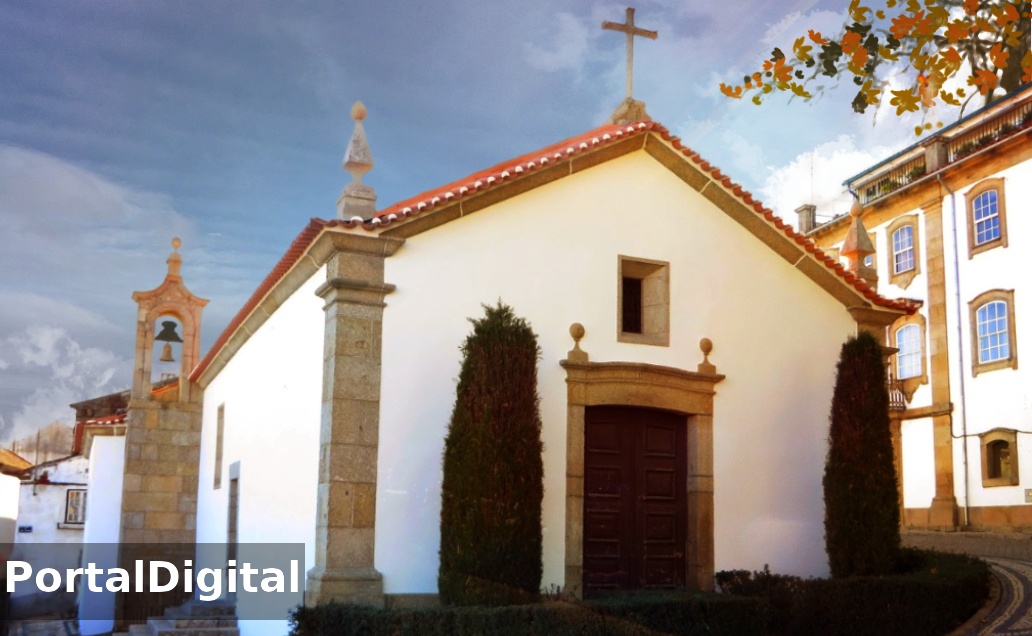
The small 16th century church is built in a quadrangular plan and the structure is reinforced by the arrangement of four buttresses.
On the facade, the Romanesque model was maintained on the main portal, but it is clear that its remodeling added an archivolt over the gable of the frontispiece where a bell tower was placed.
On the left side of the main portal was engraved "This Chapel Made João Loezello, a reference to the original founder of the chapel”.
In the front space was inscribed "This Chapel Ordered Aires Botelho to be Made Again by A. Botelho His Son for Him and His Descendants in the year 1542".
In the 16th century, this chapel was attached to Solar dos Botelhos, so in 1542 the temple was rebuilt by order of Aires Botelho, as evidenced by an inscription on the main portal.
The Chapel of São Pedro has a longitudinal plan consisting of a nave, a narrower main chapel and addors, a sacristy and a bell tower and was built in the 19th century on a pre-existing structure.
The interior is a unique space, without a chancel, covered by a starry vault, whose closures are decorated with the Cross of Christ, zoomorphic and anthropomorphic motifs.
In the wall on the Gospel side, two archosoliums were opened, twinned in a depressed arch, which possibly house tombs.
The main altar, elevated by a step that differentiates it from the rest of the space, has a pediment covered with Spanish-Moorish tiles.
In the 19th century, the temple was later used as a warehouse and only in 1948 was the Chapel of Saint Peter reopened for religious ceremonies and began to be used as a mortuary chapel from the 1980s onwards.
The small 16th century church is built in a quadrangular plan and the structure is reinforced by the arrangement of four buttresses.
On the facade, the Romanesque model was maintained on the main portal, but it is clear that its remodeling added an archivolt over the gable of the frontispiece where a bell tower was placed.
On the left side of the main portal was engraved "This Chapel Made João Loezello, a reference to the original founder of the chapel”.
In the front space was inscribed "This Chapel Ordered Aires Botelho to be Made Again by A. Botelho His Son for Him and His Descendants in the year 1542".
In the 16th century, this chapel was attached to Solar dos Botelhos, so in 1542 the temple was rebuilt by order of Aires Botelho, as evidenced by an inscription on the main portal.
The Chapel of São Pedro has a longitudinal plan consisting of a nave, a narrower main chapel and addors, a sacristy and a bell tower and was built in the 19th century on a pre-existing structure.
The interior is a unique space, without a chancel, covered by a starry vault, whose closures are decorated with the Cross of Christ, zoomorphic and anthropomorphic motifs.
In the wall on the Gospel side, two archosoliums were opened, twinned in a depressed arch, which possibly house tombs.
The main altar, elevated by a step that differentiates it from the rest of the space, has a pediment covered with Spanish-Moorish tiles.
In the 19th century, the temple was later used as a warehouse and only in 1948 was the Chapel of Saint Peter reopened for religious ceremonies and began to be used as a mortuary chapel from the 1980s onwards.
Classification Chapel of Saint Peter
The Chapel of São Pedro was classified as a National Monument on July 31, 1924.