
Located in the parish of Glória, municipality of Aveiro, central Portugal
The Parish of Nossa Senhora da Glória de Aveiro was created on October 13, 1835 and corresponds to half of the parish district of the city of Aveiro.
On October 13, 1835, two parishes were created in the city of Aveiro (Our Lady of Glory and Our Lady of Presentation-Vera Cruz).
To the south of the central channel of the ria, the Parish of Nossa Senhora da Glória was created, with the Parish Church being installed in the Church of the Dominican Convent of Nossa Senhora da Misericórdia in Aveiro.
The new parish annexed the extinct parishes of São Miguel and Espírito Santo, as well as the parish churches and chapels connected to them. Since the restoration in 1938, the title of Cathedral of the Diocese of Aveiro has belonged to it.
The current Cathedral of Aveiro was once the church of the Convent of São Domingos, the first conventual institution established within the perimeter of the walls of Aveiro and founded in 1423, as a result of the apparition of the Virgin to Afonso Domingos the Elder, this institution of Dominican religious people immediately received the approval of Infante D. Pedro, then Duke of Aveiro.
Little or nothing of its 16th century layout remains, resulting in the current church being an architectural campaign from the 16th and 17th centuries unified by the baroque decorative intervention of the 18th century, also responsible for opening the windows and restructuring the high choir.
The layout of the temple has a Latin cross plan with a single nave and side chapels that communicate with each other, being preceded by a galilee.
The transept and the main chapel were the subject of an intervention in the 20th century, under a project by the Porto architect Abrunhosa de Brito, who unified this space, leaving visible testimonies of the original 15th century construction, namely the bell tower where one of the most interesting pieces of this ensemble is currently displayed, the alabaster virgin, from Nottingham.
The facade, with a Mannerist appearance, must have been remodeled in the 18th century given that the portal, dated 1719, has a clearly Baroque language, as does the finishing of the elevation.
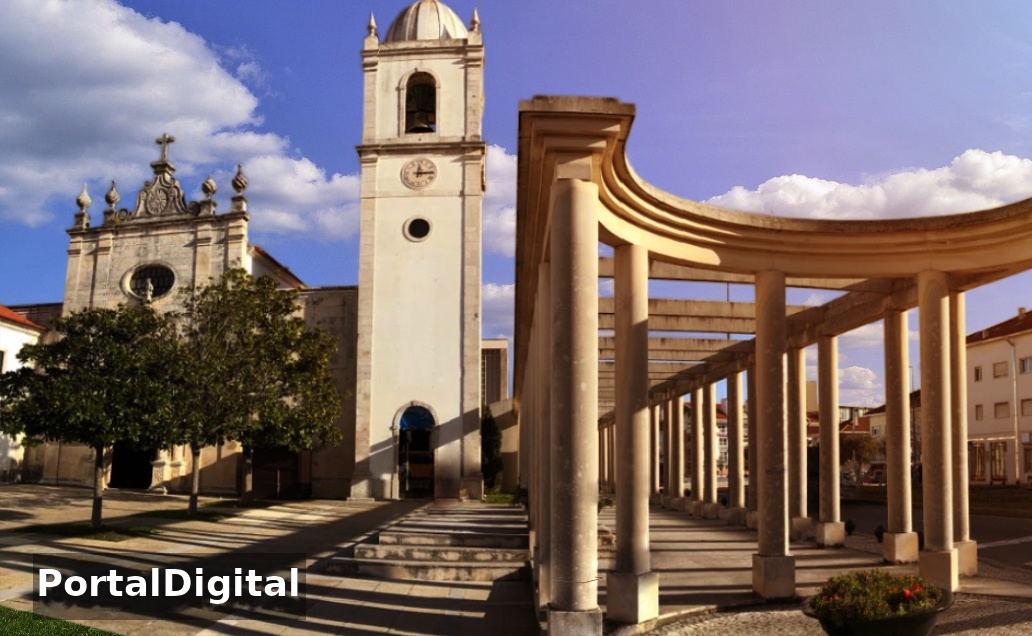
In the composition of this set, the double pseudo-Solomonic colonnade that flanks the portal, the coat of arms of the Dominican Order, and the figures of Faith, Hope and Charity stand out, above the aforementioned portico, the bell tower, where the original bell is preserved, is a work of the 19th century and was built in 1860.
On October 13, 1835, two parishes were created in the city of Aveiro (Our Lady of Glory and Our Lady of Presentation-Vera Cruz).
To the south of the central channel of the ria, the Parish of Nossa Senhora da Glória was created, with the Parish Church being installed in the Church of the Dominican Convent of Nossa Senhora da Misericórdia in Aveiro.
The new parish annexed the extinct parishes of São Miguel and Espírito Santo, as well as the parish churches and chapels connected to them. Since the restoration in 1938, the title of Cathedral of the Diocese of Aveiro has belonged to it.
The current Cathedral of Aveiro was once the church of the Convent of São Domingos, the first conventual institution established within the perimeter of the walls of Aveiro and founded in 1423, as a result of the apparition of the Virgin to Afonso Domingos the Elder, this institution of Dominican religious people immediately received the approval of Infante D. Pedro, then Duke of Aveiro.
Little or nothing of its 16th century layout remains, resulting in the current church being an architectural campaign from the 16th and 17th centuries unified by the baroque decorative intervention of the 18th century, also responsible for opening the windows and restructuring the high choir.
The layout of the temple has a Latin cross plan with a single nave and side chapels that communicate with each other, being preceded by a galilee.
The transept and the main chapel were the subject of an intervention in the 20th century, under a project by the Porto architect Abrunhosa de Brito, who unified this space, leaving visible testimonies of the original 15th century construction, namely the bell tower where one of the most interesting pieces of this ensemble is currently displayed, the alabaster virgin, from Nottingham.
The facade, with a Mannerist appearance, must have been remodeled in the 18th century given that the portal, dated 1719, has a clearly Baroque language, as does the finishing of the elevation.
In the composition of this set, the double pseudo-Solomonic colonnade that flanks the portal, the coat of arms of the Dominican Order, and the figures of Faith, Hope and Charity stand out, above the aforementioned portico, the bell tower, where the original bell is preserved, is a work of the 19th century and was built in 1860.
Classification of the Cathedral of Aveiro or Church of São Domingos
This Building has been a Property of Public Interest since 1996.