
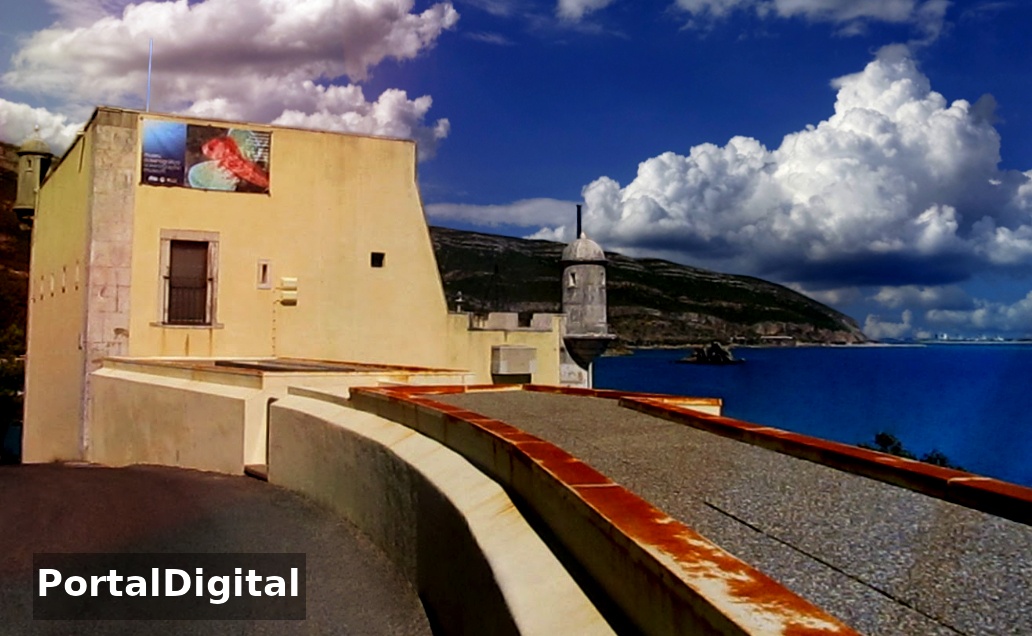
It is located at the foot of the southern slope of the mountain range of the same name, in a dominant position southwest of Portinho da Arrábida, on the north bank of the Sado river, in the Municipality and District of Setúbal, Central Portugal
The Fort complements the set of 18th century fortifications that were built in the context of the war of Restoration of Portuguese independence, stretching along the coast from Setúbal to the São Domingos da Baralha Fort near Cape Espichel.
The place took on religious dimensions from 1250 onwards, when according to tradition, Hildebrand, a merchant from the British Isles, built a small hermitage dedicated to Our Lady in thanksgiving for the miracle that saved him there from a shipwreck.
In the first half of the 16th century, between 1539 and 1542, D. João de Lencastre (1501-1571), 1st Duke of Aveiro, built the primitive convent, donated to the Spanish Franciscan Frei Martinho de Santa Maria, who wished to live there as a hermit.
The building work continued between the second half of the 16th century and the first half of the 17th century, due to the devotion of the 2nd and 3rd Dukes of Aveiro, to whom the inn and the Passos da Paixão stations are owed, and that of the 3rd Duke's daughter-in-law.
In the mid-17th century, the 4th Duke of Aveiro promoted the construction of the Bom Jesus chapel.
In the 19th century, with the extinction of religious orders in Portugal, the Convent's facilities were abandoned by the Franciscan friars (1834), being acquired by the Dukes of Palmela (1863).
At the end of the 20th century, they were acquired by Fundação Oriente (1990), which reclassified them as a cultural space.
The fortification completing the complete remodeling of the kingdom's defensive strategy implemented from the reign of D. João IV (1640-1656), comprising the defense of the Setúbal bar, this maritime fortification was only started between 1670 and 1676, under the reign of D. Pedro II (1667-1706), with the function of defending the so-called port and the Arrábida Convent, a pilgrimage destination.
His works were entirely redone under that of D. João V (1706-1750), to be considered completed in 1749, according to the epigraphic inscription on a tombstone over the Gate of Arms: “Governing these kingdoms and lordships of Portugal, the very high and powerful prince D. Pedro, Our Lord, by the Marquis of Fronteira, of the Council of War, his Gentle-Man of the Chamber, vedor of his Treasury, Master of Field General of the Court, Estremadura, Cascaes and Setúbal, [ordered] this fortress to be built to defend this port and [bar] of Arrábida and its seas in the year 1676. By order of S. M. everything was rebuilt from the foundations, the roads were made again and ended up in MDCCXLIX".
At the end of the 18th century (1798) it was in operation until the reign of D. Luís (1861-1889), when, faced with the loss of its defensive function due to the evolution of military resources and the abandonment of the Convent's facilities, it was deactivated.
At the beginning of the 20th century it was leased to a private individual, and from 1932 onwards it was adapted to serve as a guesthouse by Sebastião da Gama's parents, which he carried out until 1976.
From 1978 onwards, the property became part of the Arrábida Natural Park, becoming considered a Property of Public Interest.
Since then, consolidation and restoration works have been carried out, adapting the monument to the function of an Oceanographic Museum (1991), which maintains a marine biology center on site, a small shop sells items related to the protected area of the park and offers coffee to visitors.
A small sea fort, it has an organic polygonal plan with a hexagonal earthwork, four parapets on the sea side, the service facilities are currently reclassified as aquarium and video exhibition rooms.
In the chapel you can see an expressive image of Our Lady in lioz stone with a 17th century appearance.
The place took on religious dimensions from 1250 onwards, when according to tradition, Hildebrand, a merchant from the British Isles, built a small hermitage dedicated to Our Lady in thanksgiving for the miracle that saved him there from a shipwreck.
In the first half of the 16th century, between 1539 and 1542, D. João de Lencastre (1501-1571), 1st Duke of Aveiro, built the primitive convent, donated to the Spanish Franciscan Frei Martinho de Santa Maria, who wished to live there as a hermit.
The building work continued between the second half of the 16th century and the first half of the 17th century, due to the devotion of the 2nd and 3rd Dukes of Aveiro, to whom the inn and the Passos da Paixão stations are owed, and that of the 3rd Duke's daughter-in-law.
In the mid-17th century, the 4th Duke of Aveiro promoted the construction of the Bom Jesus chapel.
In the 19th century, with the extinction of religious orders in Portugal, the Convent's facilities were abandoned by the Franciscan friars (1834), being acquired by the Dukes of Palmela (1863).
At the end of the 20th century, they were acquired by Fundação Oriente (1990), which reclassified them as a cultural space.
The fortification completing the complete remodeling of the kingdom's defensive strategy implemented from the reign of D. João IV (1640-1656), comprising the defense of the Setúbal bar, this maritime fortification was only started between 1670 and 1676, under the reign of D. Pedro II (1667-1706), with the function of defending the so-called port and the Arrábida Convent, a pilgrimage destination.
His works were entirely redone under that of D. João V (1706-1750), to be considered completed in 1749, according to the epigraphic inscription on a tombstone over the Gate of Arms: “Governing these kingdoms and lordships of Portugal, the very high and powerful prince D. Pedro, Our Lord, by the Marquis of Fronteira, of the Council of War, his Gentle-Man of the Chamber, vedor of his Treasury, Master of Field General of the Court, Estremadura, Cascaes and Setúbal, [ordered] this fortress to be built to defend this port and [bar] of Arrábida and its seas in the year 1676. By order of S. M. everything was rebuilt from the foundations, the roads were made again and ended up in MDCCXLIX".
At the end of the 18th century (1798) it was in operation until the reign of D. Luís (1861-1889), when, faced with the loss of its defensive function due to the evolution of military resources and the abandonment of the Convent's facilities, it was deactivated.
At the beginning of the 20th century it was leased to a private individual, and from 1932 onwards it was adapted to serve as a guesthouse by Sebastião da Gama's parents, which he carried out until 1976.
From 1978 onwards, the property became part of the Arrábida Natural Park, becoming considered a Property of Public Interest.
Since then, consolidation and restoration works have been carried out, adapting the monument to the function of an Oceanographic Museum (1991), which maintains a marine biology center on site, a small shop sells items related to the protected area of the park and offers coffee to visitors.
A small sea fort, it has an organic polygonal plan with a hexagonal earthwork, four parapets on the sea side, the service facilities are currently reclassified as aquarium and video exhibition rooms.
In the chapel you can see an expressive image of Our Lady in lioz stone with a 17th century appearance.