
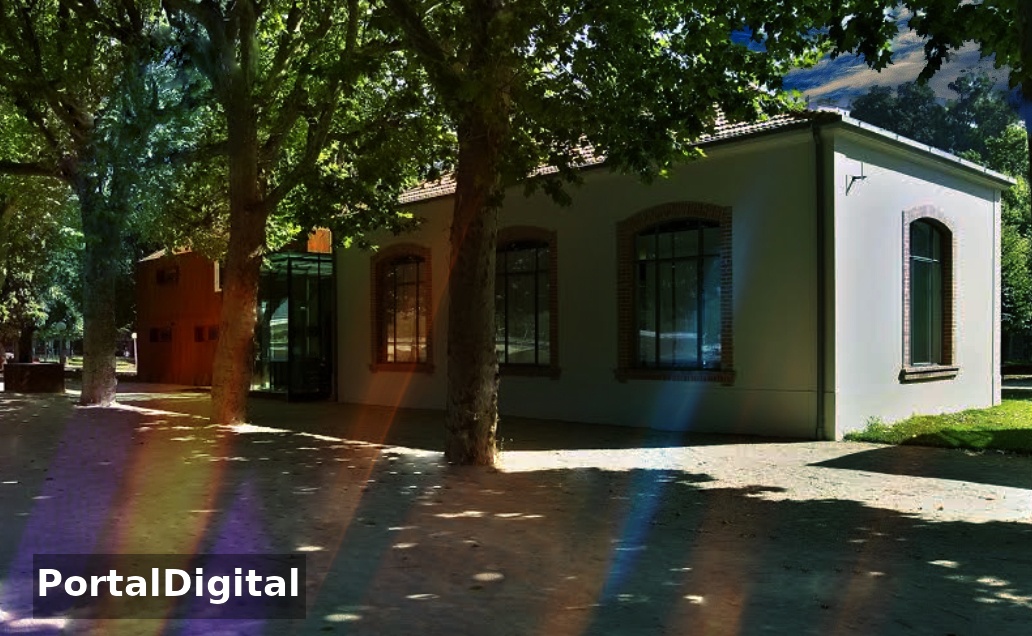
It is located on Avenida Emídio Navarro, in the city and municipality of Coimbra, central Portugal
The protocol established between the CoimbraPolis Society and the Coimbra City Council allowed the old Water Collection Station building to be recovered and returned to the city.
The project in which the municipal company Águas de Coimbra participates makes it possible to enjoy a beautiful museum space “Museu da Água de Coimbra” which is located in the City Park.
The museum space presented here is an open, dynamic and interactive space of creativity and has a deck overlooking the Mondego River.
Águas de Coimbra has sought to intervene with younger audiences in order to teach them to value environmental issues, and in particular the use of water, but also to understand the evolution of water supply in cities.
In this sense, the privileged audience for this project are schools (children, teenagers and educators) but there is also a place for adults in a place that has as its concept the appreciation of the environment such as not wasting water (an exhaustible natural resource) and everything that nature gives us because nature is not an inexhaustible source.
Water is essential for our lives, without it in adequate quantity and quality, economic and social development, our routine and survival itself are compromised. (We only exist because there is water on Earth)
The main objectives of the Water Museum are: to understand the hydrological cycle and the urban water cycle, the importance of water in the context of population development, to raise awareness of the issues of pollution, water waste and the efficient use of resources, and to value the natural and historical heritage related to water supply.
The Coimbra Water Museum's Activity Plan includes a diverse set of Environmental Education and Awareness initiatives that aim to inform and enlighten people about environmental problems and their possible solutions, and seeking to transform citizens into active participants in the protection and defense of natural values.
The Museum seeks to reach all audiences and generations through exhibitions, artistic installations, conferences, workshops and musical moments, highlighting renowned local and national authors, and discovering new values in the arts.
Renewable resources can be renewed by nature or even by human action, as is the case with vegetation, animals and water.
Inexhaustible resources are those that do not end, like wind and sunlight, but here there must also be adequate management, since the exploitation of these resources can generate various environmental and social impacts.
In the place where wind turbines are installed, in addition to affecting the migration behavior of birds, it is also associated with noise pollution.
Solar energy, which requires the installation of plants and equipment, also affects the habitat of numerous species, altering their reproduction, feeding and movement patterns.
International examples such as Brazil have a good volume of water, but use the resource poorly.
Water scarcity is a reality in the world, and dozens of countries are already facing this problem, which has been evident in the north-central part of the African continent.
The project in which the municipal company Águas de Coimbra participates makes it possible to enjoy a beautiful museum space “Museu da Água de Coimbra” which is located in the City Park.
The museum space presented here is an open, dynamic and interactive space of creativity and has a deck overlooking the Mondego River.
Águas de Coimbra has sought to intervene with younger audiences in order to teach them to value environmental issues, and in particular the use of water, but also to understand the evolution of water supply in cities.
In this sense, the privileged audience for this project are schools (children, teenagers and educators) but there is also a place for adults in a place that has as its concept the appreciation of the environment such as not wasting water (an exhaustible natural resource) and everything that nature gives us because nature is not an inexhaustible source.
Water is essential for our lives, without it in adequate quantity and quality, economic and social development, our routine and survival itself are compromised. (We only exist because there is water on Earth)
The main objectives of the Water Museum are: to understand the hydrological cycle and the urban water cycle, the importance of water in the context of population development, to raise awareness of the issues of pollution, water waste and the efficient use of resources, and to value the natural and historical heritage related to water supply.
The Coimbra Water Museum's Activity Plan includes a diverse set of Environmental Education and Awareness initiatives that aim to inform and enlighten people about environmental problems and their possible solutions, and seeking to transform citizens into active participants in the protection and defense of natural values.
The Museum seeks to reach all audiences and generations through exhibitions, artistic installations, conferences, workshops and musical moments, highlighting renowned local and national authors, and discovering new values in the arts.
Renewable resources can be renewed by nature or even by human action, as is the case with vegetation, animals and water.
Inexhaustible resources are those that do not end, like wind and sunlight, but here there must also be adequate management, since the exploitation of these resources can generate various environmental and social impacts.
In the place where wind turbines are installed, in addition to affecting the migration behavior of birds, it is also associated with noise pollution.
Solar energy, which requires the installation of plants and equipment, also affects the habitat of numerous species, altering their reproduction, feeding and movement patterns.
International examples such as Brazil have a good volume of water, but use the resource poorly.
Water scarcity is a reality in the world, and dozens of countries are already facing this problem, which has been evident in the north-central part of the African continent.