
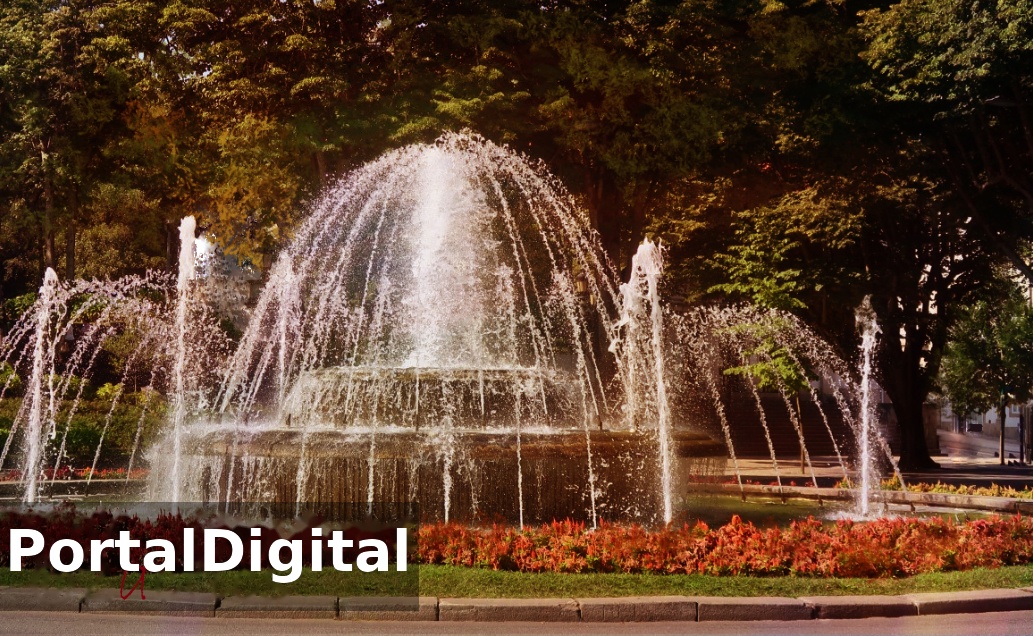
It is located in the city of Viseu, in central Portugal
The center of most cities is Rossio, officially Praça da República in Viseu, it was for centuries the city's "visiting hall".
The first references to Rossio date back to the 16th century and over the centuries there were many transformations that it underwent until its current appearance.
The place became attractive to the population from an early age, but it was mainly during the 18th and 19th centuries that it became the "Public Promenade" of Visean society, the place where people lived and walked.
The place was also a place of business, with the weekly fair and the historic Feira Franca being held there for some years and at the end of the 19th century it benefited from the construction of a bandstand that has now been removed.
To the west was the Paços do Concelho building (Municipal Chamber of Viseu), a construction from the second half of the 19th century in which municipal services were installed, covered in Portuguese pavement, centuries-old trees, garden benches and lamps.
The building forms a sober, but majestic complex in which the outlining stone of the doors and windows stands out among the white walls.
Inside, it is worth contemplating the wrought iron chandelier, the work of Arnaldo Malho, climbing the imposing stone staircase lined with colorful tiles and observing carefully the paintings on the ceiling: the central allegory and the portraits that made famous men and women of the Portuguese past, the result of the brushes of José de Almeida e Silva (1864-1945), an illustrious painter from Viseu, equally worthy of admiration is the Salão Nobre due to the work in wood that was the work of Mestre Loureiro.
To the north of Rossio is a graceful garden of exaltation to all Mothers materialized in a sculpture (1940) by the statuary José de Oliveira Ferreira.
The access ramp to the garden is defined by a granite balustrade and enriched with tile panels (1931) representing the various regional activities, designed by Joaquim Lopes (1886-1956).
On the opposite side, to the south stands the Church of the Thirds of S. Francisco amidst the greenery of nature and to the east stands the Banco de Portugal building.
In Rossio there are numerous arteries, such as Rua Formosa, despite the transformations, it still retains parts of "Art Nouveau" style buildings.
Praça da República has been the main nucleus of the city since 1886, it is also known as Rossio and is distinguished by its administrative and economic features present in the buildings of the City Council (late 19th century), the Bank of Portugal (1930) and the Caixa Geral de Depósitos.
In Rossio we also find an allegory to the rural world represented in a tile panel dating from 1930 and designed by Joaquim Lopes where the visitor cannot fail to observe the emblematic figure of Capucha
The first references to Rossio date back to the 16th century and over the centuries there were many transformations that it underwent until its current appearance.
The place became attractive to the population from an early age, but it was mainly during the 18th and 19th centuries that it became the "Public Promenade" of Visean society, the place where people lived and walked.
The place was also a place of business, with the weekly fair and the historic Feira Franca being held there for some years and at the end of the 19th century it benefited from the construction of a bandstand that has now been removed.
To the west was the Paços do Concelho building (Municipal Chamber of Viseu), a construction from the second half of the 19th century in which municipal services were installed, covered in Portuguese pavement, centuries-old trees, garden benches and lamps.
The building forms a sober, but majestic complex in which the outlining stone of the doors and windows stands out among the white walls.
Inside, it is worth contemplating the wrought iron chandelier, the work of Arnaldo Malho, climbing the imposing stone staircase lined with colorful tiles and observing carefully the paintings on the ceiling: the central allegory and the portraits that made famous men and women of the Portuguese past, the result of the brushes of José de Almeida e Silva (1864-1945), an illustrious painter from Viseu, equally worthy of admiration is the Salão Nobre due to the work in wood that was the work of Mestre Loureiro.
To the north of Rossio is a graceful garden of exaltation to all Mothers materialized in a sculpture (1940) by the statuary José de Oliveira Ferreira.
The access ramp to the garden is defined by a granite balustrade and enriched with tile panels (1931) representing the various regional activities, designed by Joaquim Lopes (1886-1956).
On the opposite side, to the south stands the Church of the Thirds of S. Francisco amidst the greenery of nature and to the east stands the Banco de Portugal building.
In Rossio there are numerous arteries, such as Rua Formosa, despite the transformations, it still retains parts of "Art Nouveau" style buildings.
Praça da República has been the main nucleus of the city since 1886, it is also known as Rossio and is distinguished by its administrative and economic features present in the buildings of the City Council (late 19th century), the Bank of Portugal (1930) and the Caixa Geral de Depósitos.
In Rossio we also find an allegory to the rural world represented in a tile panel dating from 1930 and designed by Joaquim Lopes where the visitor cannot fail to observe the emblematic figure of Capucha